Advanced OpenModelica: Modular System Modeling
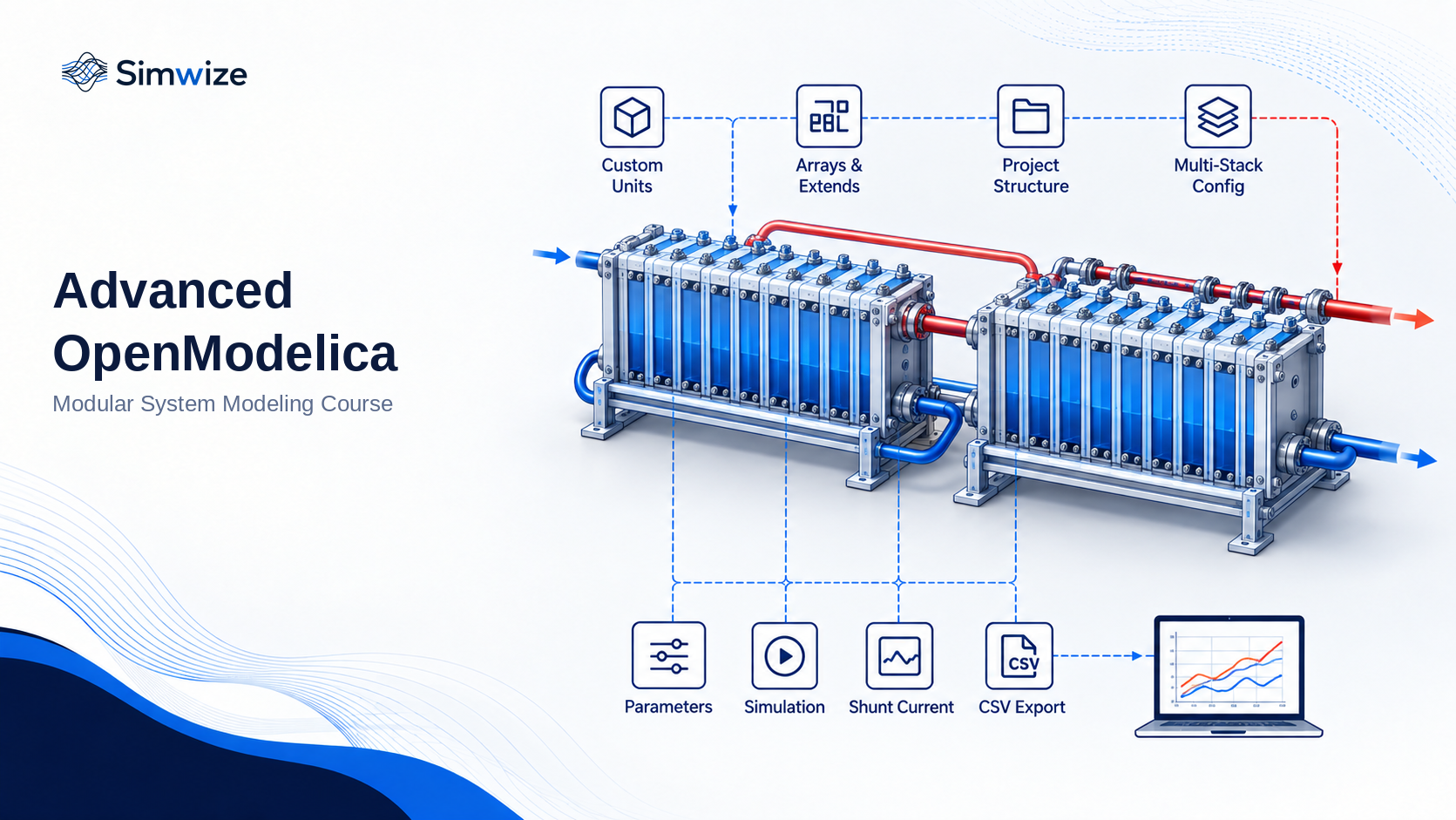
About Course
Welcome to Advanced OpenModelica: Modular System Modeling, a hands-on course designed to enhance your system modeling skills for energy and power applications. Learn structured, modular, and scalable workflows in OMEdit to build multi-cell and multi-stack models, run simulations, and analyze results.
This course builds on foundational OpenModelica knowledge, teaching you to design clean, professional models, manage parameters systematically, implement parameterized blocks, and create icons and interfaces for modular systems, skills directly applicable in engineering, research, and industrial projects.
What You Will Learn
- Design modular, scalable system models
- Extend component models to multi-component
- Define and manage parameters efficiently
- Use arrays, extensions, and blocks to streamline modeling
- Build and organize visual and textual models in OMEdit
- Create icons and interfaces for modular model instantiation
- Run simulations and analyze system behavior, including shunt currents
- Export results as CSV for further analysis
- Apply best practices for maintainable, extensible models
Who This Course Is For
- Engineers, researchers, and students in energy, power, or multi-domain systems
- Anyone with basic OpenModelica knowledge seeking advanced skills
- Learners interested in structured, modular system modeling for practical applications
Course Highlights
- Project-driven, hands-on approach with real-world energy and power systems
- Step-by-step guidance for advanced OMEdit workflows
- Modular system design and structured project organization
- Multi-cell and multi-stack modeling exercises
- Simulation, analysis, and CSV export techniques
- Focus on scalable, professional, and maintainable models
Why This Course Exists
This course fills the gap in structured, practical training for complex system modeling. Most advanced resources are either too theoretical or lack professional workflows. This course provides hands-on, project-focused learning to develop scalable, analyzable models.
What Comes Next
Future courses will extend this work to the hydraulic side, covering flow battery dynamics, fluid libraries, and controller design, and demonstrate integration of electrical and hydraulic systems to explore optimal operation for combined systems.
Course Content
Course Introduction
-
Course Introduction and Learning Approach
Project Deep Dive
Modeling Fundamentals and Project Structure
Multi-Cell Stack Modeling and Simulation
Modular Multi-Stack Modeling and Exporting Results
Student Ratings & Reviews